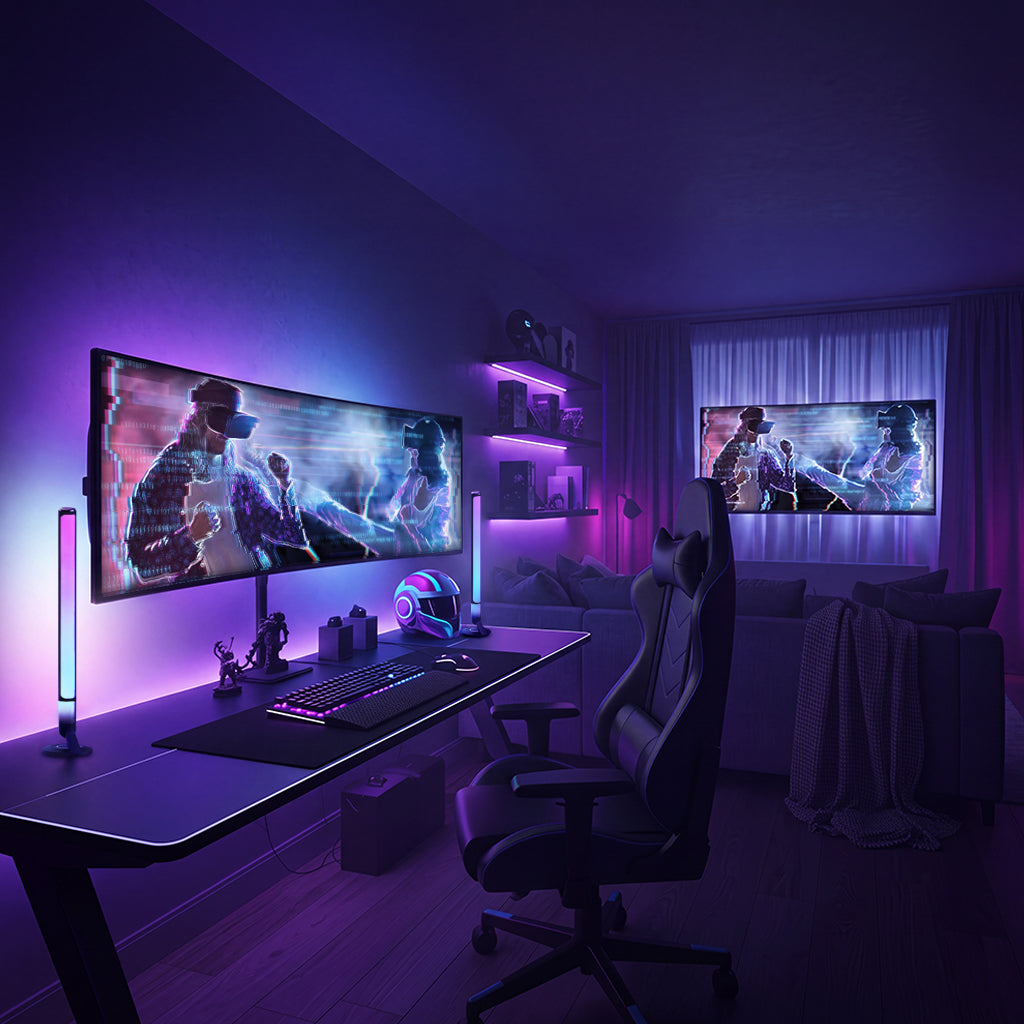
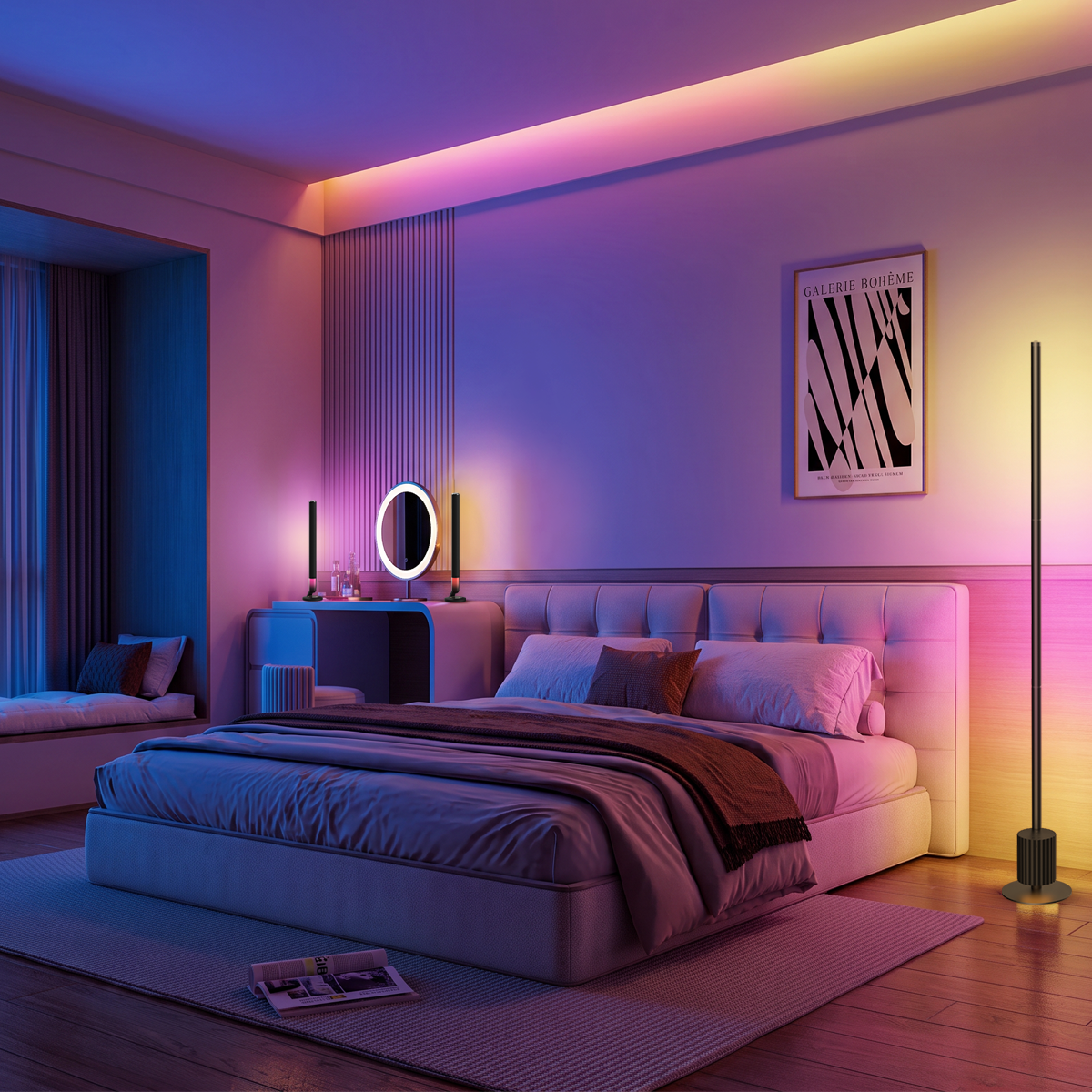
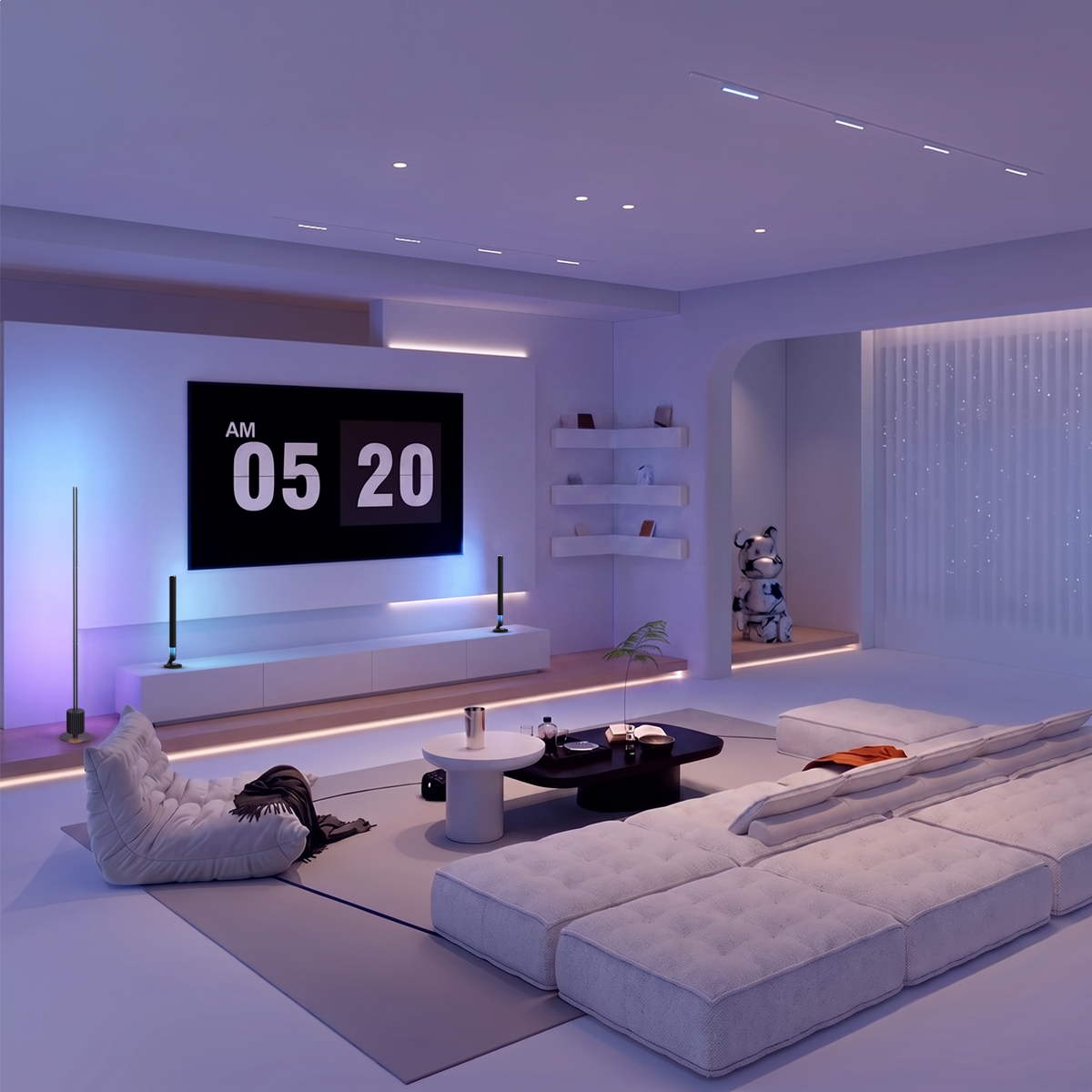
In the mainstream smart home market, lighting is often marketed as an extension of home entertainment. Consumers are flooded with advertisements showing vibrant RGB sync sweeps, light panels that flash to the beat of video games, and dynamic neon light strips wrapping around gaming desks.
However, for professionals whose careers involve prolonged visual attention—such as digital artists, industrial designers, video editors, software developers, and remote workers—there is a meaningful difference between "entertainment lighting" and lighting that supports visual comfort.
Dynamic color effects are excellent for creating a lifestyle mood, but deep-focus environments also need stable white light, accurate color perception, and reduced glare. To understand why, we must look past the convenience of app controls and decode the underlying science of light quality: the Color Rendering Index (CRI), R9 spectrum value, and spectral integrity.
The Optical Science: Ra vs. R9 Spectrum
When we evaluate light, our eyes do not just process brightness (lumens); they process how accurately a light source reveals the true colors of physical objects compared to natural sunlight. This accuracy is measured by the Color Rendering Index (CRI).
Most standard commercial LED lamps boast a CRI of Ra 80 to 85. While this sounds adequate, the traditional "Ra" score is merely an average of the first eight pastel colors (R1 through R8). This testing method contains a critical loophole: it completely excludes saturated, vibrant colors, most notably R9 (Deep Red).
Why R9 is the Crucial Metric for Productivity
Deep Red (R9) is one of the most vital wavelengths for human biological comfort and architectural accuracy:
Organic Materials: It is essential for rendering natural wood grains, paper textures, and textile fabrics accurately.
Human Vitality: High R9 values accurately illuminate skin tones, preventing a sickly, pale, or greenish tint under artificial light.
Visual Sharpness: Without sufficient red wavelengths in a white light spectrum, the human eye has to work significantly harder to distinguish contrast and sharp boundaries, leading directly to afternoon eye strain.
For color-sensitive work or long visual sessions, a CRI Ra 90+ combined with a strong R9 score can create a more continuous, high-fidelity spectrum that better resembles the full-bodied qualities of natural daylight.

Technical Comparison: Smart Lighting vs. Architectural Spectrum
To help high-demand professionals navigate the market, the matrix below details how standard consumer smart lighting ecosystems compare to architectural-grade systems engineered for wellness and focus:
|
Technical Parameter |
RGB-Centric Smart Lamps (Standard Consumer Brands) |
Classic Smart Home Ecosystems (Standard Mainstream) |
Nurmina Product Positioning (Desk Lamp Pro 9080 / Floor Lamp Pro 9180) |
|
Color Rendering Index (CRI Ra) |
Typically Ra 80 - 85. Colors appear slightly muted or muddy under white light modes. |
Ra 80 - 90. Solid performance for general residential walkways. |
Floor Lamp Pro 9180: CRI Ra >90 for higher color accuracy. Desk Lamp Pro 9080: do not position as a CRI 90+ professional work light unless a separate specification is confirmed. |
|
R9 (Deep Red) Value |
Frequently neglected or falls below 50. Can cause skin tones to look washed out. |
Varies widely, usually lingering around 50 - 60. |
Floor Lamp Pro 9180: stronger color-fidelity positioning. Desk Lamp Pro 9080: suitable as a complementary smart desk ambience layer rather than the primary reference for high-R9 task lighting. |
|
Optical Distribution Path |
Symmetrical diffused light. Often creates direct glare or harsh hotspot reflections on display monitors. |
Standard downward cones or omnidirectional ambient bulbs. |
Desk Lamp Pro 9080 supports localized desk ambience and directional comfort; Floor Lamp Pro 9180 provides softer room-level indirect illumination for a more balanced workspace atmosphere. |
|
Primary Engineering Focus |
Saturated RGB effects, gaming integrations, and dynamic pattern syncing. |
General smart home connectivity, scheduling, and standard residential ambiance. |
Layered smart lighting: Desk Lamp Pro 9080 for desk ambience and setup enhancement; Floor Lamp Pro 9180 for high-CRI ambient lighting and visual comfort. |
The Ergonomic Cost of Low-Quality Spectrums
When an LED light fixture cuts corners on spectral integrity, it creates a jagged, spikey spectral power distribution (SPD)—typically characterized by an intense, isolated blue light spike and a massive drop-off in the red and green wavelengths.
Even if the lamp is set to a "warm white" setting via an app, your brain still registers the underlying unevenness. This incomplete spectrum triggers several undesirable conditions:
Metamerism Failure: Colors that look correct under daylight suddenly shift into completely different hues when brought to your desk, making accurate design or color grading impossible.
Micro-Flicker & Pupillary Stress: Lower-tier smart components often use low-frequency Pulse Width Modulation (PWM) to dim lights. While invisible to the naked eye, this micro-flicker causes the ciliary muscles in your eyes to contract continuously, leading to dry eyes and headaches.
Suppressed Melatonin Secretion: An unoptimized blue spike during evening hours tricks the suprachiasmatic nucleus into believing it is midday, severely disrupting your sleep architecture and next-day recovery.
Engineering the Solution: The Nurmina Spectrum Approach
For Nurmina, the lighting strategy is not to make every product serve the same role. The Nova Floor Lamp Pro 9180 is better positioned as the high-CRI ambient and room-level lighting option, while the Desk Lamp Pro 9080 is better positioned as a smart desk companion for localized ambience, directional comfort, and setup enhancement.
The CRI Ra 90+ claim should be tied specifically to the Floor Lamp Pro 9180, which is the Nurmina product currently supported by the >90 color-rendering specification.
In practice, the Desk Lamp Pro 9080 can help shape the mood and visual structure of a desk setup, while the Floor Lamp Pro 9180 can provide softer room-level illumination with stronger color fidelity. This creates a more balanced lighting environment without overstating the Desk Lamp Pro 9080 as the primary source for precision design, editing, or color-grading work.

To see how different lighting positions affect visual comfort, check out our layout guide: The Ultimate Ergonomic Lighting Guide for Remote Professionals: Desk Lamp vs. Floor Lamp.
FAQ: Deep Diving Into Light Fidelity & Workspace Metrics
Q: Does a high CRI rating mean a light will be too bright for evening work?
A: Not at all. CRI measures light quality, not quantity (brightness). A premium lamp like the Nurmina Floor Lamp Pro 9180 can be dimmed down to a soft, low-lux glow for evening wind-downs while still maintaining its Ra 90+ ability to render colors accurately without turning the room gray or muddy.
Q: Why do many gaming-oriented RGB smart lights have lower CRI ratings?
A: Engineering a diode array to produce highly saturated red, green, and blue light for entertainment requires different phosphor blends than engineering a continuous, high-CRI white light spectrum. Entertainment brands often prioritize dynamic colored effects over structural white light fidelity. In Nurmina's product lineup, the Floor Lamp Pro 9180 is the stronger reference point for high-CRI room lighting, while the Desk Lamp Pro 9080 should be described more carefully as a smart desk ambience and comfort-supporting light.
Q: How does spectral integrity directly impact software developers who only look at code?
A: Even if you do not work with colors, you work with text contrast. Low-quality lighting can reduce the perceived crispness of text boundaries and increase glare around monitors or desk surfaces. A high-CRI room light such as the Nurmina Floor Lamp Pro 9180 can improve overall visual comfort, while the Desk Lamp Pro 9080 can be used as a complementary layer for desk atmosphere rather than the main precision work light.